
If you've spent years building a network marketing business, diversification doesn't mean abandoning what you've built. It means building a stronger business around it.
Share this post
If you've spent years building a network marketing business, starting over may be the last thing you want to do.
You may still like your company.
You may love the products.
You may have friendships throughout your organization.
You may even be earning good money.
But there is an important question experienced network marketers eventually need to consider:
How much of what you've built actually belongs to you—and how much depends on one company continuing to perform?
Diversification doesn't necessarily mean abandoning what you've built.
It can mean building a stronger business around it.
The Problem With Depending on One Company
Traditional network marketing can create an unusual form of business risk.
You may consider yourself an independent entrepreneur, yet one company may control many of the things your business depends upon:
- Products
- Pricing
- Compensation plan
- Policies
- Technology
- Shipping and fulfillment
- Leadership
- Market positioning
- Your position in its genealogy
- The rules governing your participation
Most of those things are outside your direct control.
That doesn't make network marketing bad.
It means concentration creates risk.
If everything is working, that concentration may not seem important.
But circumstances can change.
Companies can modify compensation plans. Products can lose momentum. Policies can change. Leadership can change. Companies can be acquired or reorganized. Competitors can enter the market. Technology can disrupt an industry. And occasionally companies fail altogether.
The question therefore isn't necessarily:
"Should I leave my company?"
A better question may be:
"How can I become less dependent on any single company?"
Think Like a Business Owner, Not a Brand Employee
There is an important distinction between building your business and building someone else's brand.
A genuine entrepreneur can value a brand without allowing that brand to become their entire business identity.
Ask yourself:
Am I using the brand to build my business—or is the brand using me to build theirs?
Those are not always the same thing.
Your relationships, reputation, communication skills, leadership ability, audience, knowledge and entrepreneurial experience can potentially have value beyond one particular product or company.
That is where diversification begins.
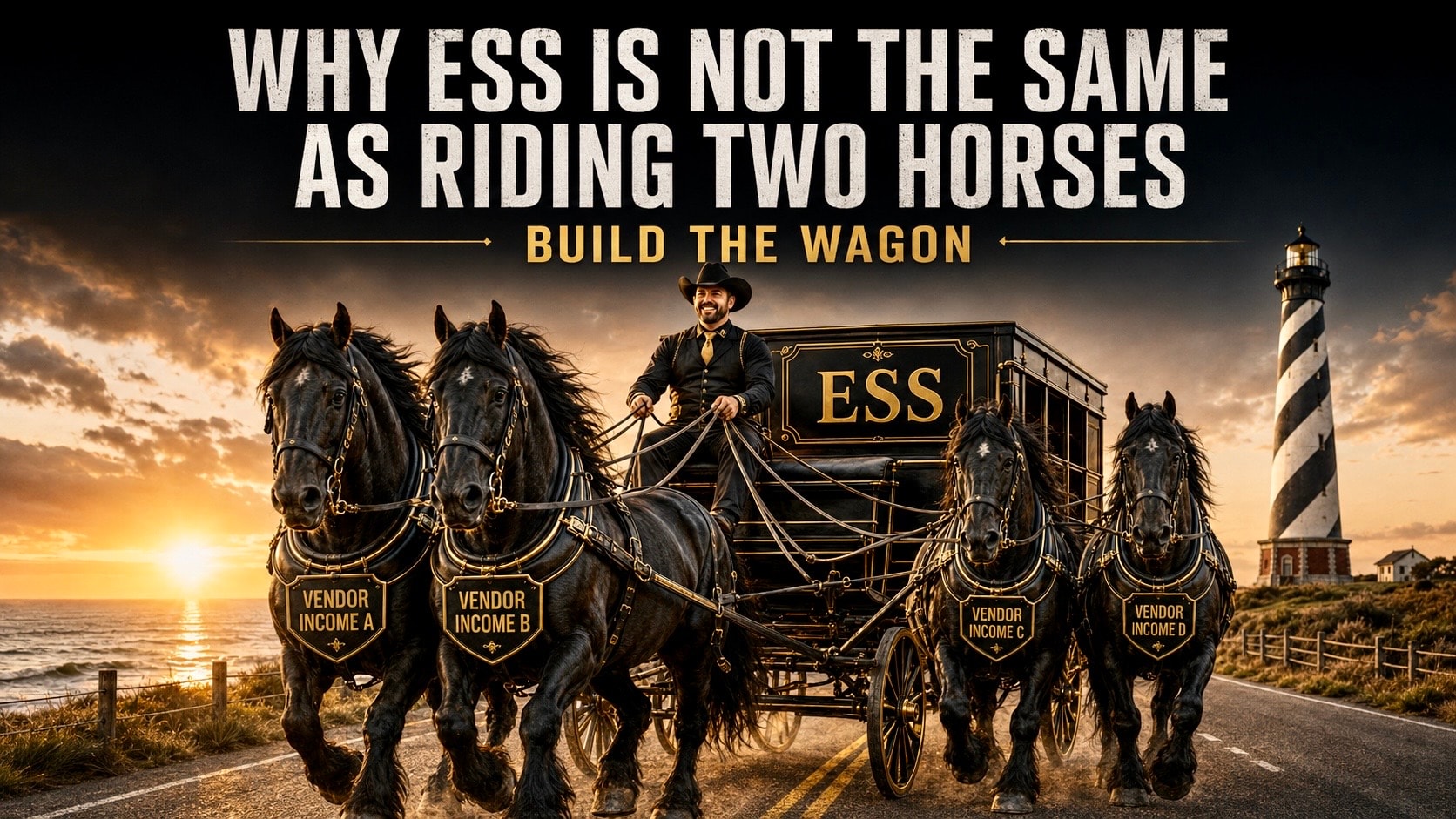
The Wagon and the Horses
Here's a simple way to visualize it.
Imagine your entrepreneurial business as a wagon.
Now imagine that one network marketing company is the horse pulling it.
If that horse is healthy and strong, everything moves beautifully.
But what happens if that horse gets injured?
Your wagon may stop.
Now imagine instead that your wagon can appropriately utilize several horses.
- One might represent your primary network marketing company.
- Another might represent an affiliate relationship.
- Another might represent a complementary product or service.
- Another might represent coaching, content, referrals, or another legitimate source of business revenue.
If circumstances change with one source, you still have the wagon.
The mistake is believing that the horse is the business.
You're building the wagon.
Companies, products and income sources can be horses that help pull it.
Diversification Does NOT Mean Joining Everything
There is another extreme to avoid.
Diversification doesn't mean signing up for every new opportunity that appears.
That can create confusion, destroy focus and damage credibility.
Good diversification is intentional.
Before adding another business relationship, consider questions such as:
- Does it complement what I'm already doing?
- Does it serve people I already know?
- Does it create unnecessary conflicts with my existing company?
- Am I permitted to participate under my current agreements and policies?
- Can I explain the relationship simply?
- Does it strengthen my business—or merely distract me?
Sometimes the correct decision is to add something. Sometimes the correct decision is to stay exactly where you are.
Diversification should be strategic, never impulsive.
Protect the Asset That Matters Most
After years in network marketing, your greatest asset may not be your position in a compensation plan.
It may be your relationships.
Think about the people you've met. People you've coached. People you've helped. People who trust you. People you've traveled with. People whose families you've come to know.
Yet traditional organizations can sometimes make those relationships feel inseparable from a particular company.
A stronger entrepreneurial philosophy asks:
Can we build relationships that outlive individual products, compensation plans and companies?
Products change. Companies change. Technology changes. Compensation plans change.
Relationships can endure.
That's an important form of business security.
Build Around People Rather Than Products
Products matter.
But products alone don't create durable organizations.
People do.
One approach to diversification is therefore to reverse the traditional order.
Instead of:
Company → Product → Compensation Plan → People
think:
People → Relationships → Coaching → Systems → Appropriate Products and Opportunities
That subtle change can dramatically alter how someone thinks about network marketing.
The entrepreneur becomes the foundation.
The outside company becomes a business relationship.
You Probably Don't Need Hundreds of Personally Sponsored People
Another misconception is that diversification requires massive recruiting.
It doesn't necessarily.
A more focused approach can be to identify a small number of serious entrepreneurial people, work closely with them and teach them to do the same.
For example, 3 people can potentially teach 3. Those 3 can teach 3. A simple pattern becomes:
3 → 9 → 27 → 81 → 243
The important word is potentially.
Real organizations never duplicate perfectly. People quit. Some never begin. Some move slowly. Others become exceptional leaders.
The numbers aren't an income promise. They simply demonstrate why duplication can matter more than massive personal recruiting.
Sponsor People Instead of Merely Recruiting Them
There is another distinction worth considering.
Recruiting can end when somebody enrolls.
Sponsoring begins when somebody enrolls.
A sponsor takes responsibility for helping another person understand what to do next. That means:
- Tell them.
- Show them.
- Do it with them.
- Review.
Information alone is increasingly inexpensive. AI can provide information almost instantly.
But implementation remains difficult.
That's why: The information isn't the secret. Implementation is where coaching becomes valuable.
A Different Approach: Exclusive Social Synergy
These ideas are part of the thinking behind Exclusive Social Synergy, or ESS.
ESS is a private, approval-based entrepreneurial coaching community designed primarily for network and affiliate marketers who want to explore a more diversified and relationship-centered approach to building.
ESS is not intended to simply become another company that someone abandons their existing business to join.
The broader idea is different:
Build a stronger entrepreneurial structure around the person—not around one particular company.
Where appropriate and permitted, that structure may work alongside outside companies, products, services and affiliate relationships rather than requiring everything to depend upon one vendor.
ESS emphasizes:
- People over products.
- Sponsoring over recruiting.
- Qualification over closing.
- Implementation over information.
- Relationships over transactions.
- Diversification over unnecessary dependence.
- Ownership over brand dependency.
"We Qualify — Never Close"
ESS also takes a different approach to prospecting.
Rather than trying to convince everyone to participate, the philosophy is:
We qualify — never close.
We select — never sell.
That means the objective isn't to pressure someone into saying yes. It is to determine whether there is a genuine fit.
A small number of committed people can potentially be far more valuable than a large number of people who were persuaded to join but never truly wanted to build.
Can You Keep Your Existing Company?
Potentially, yes.
The entire point of diversification can be defeated if "diversification" simply means abandoning Company A and becoming completely dependent upon Company B.
However, every network marketing, affiliate and direct-selling company has its own policies.
Before participating in another business, members should carefully review their existing company's policies regarding:
- Multiple business participation
- Cross-recruiting
- Solicitation
- Competitive products
- Social media
- Confidential information
- Genealogy
- Customer relationships
ESS does not encourage anyone to violate another company's policies, contractual obligations or applicable laws.
Five Questions Every Experienced Network Marketer Should Ask
You don't need to join anything to conduct a useful business-risk assessment.
Ask yourself:
- If my primary company disappeared tomorrow, what would I still own or control?
- If my compensation plan changed significantly, what other sources of business income would remain?
- Are my relationships connected primarily to me—or primarily to the company?
- Am I developing entrepreneurs who can think independently, or people who depend upon me for every decision?
- Am I building a business—or simply building one company's brand?
Your answers can reveal where your greatest vulnerabilities are.
You May Not Need to Start Over
Perhaps the biggest misconception about diversification is that it requires throwing away everything you've already built.
It shouldn't.
Your experience matters. Your relationships matter. Your reputation matters. Your communication skills matter. Your leadership ability matters. Your mistakes matter. Even the years when your business didn't grow the way you wanted can contain valuable lessons.
The objective shouldn't necessarily be to start over.
It may be to finally build a structure capable of benefiting from everything you've already learned.
The Bigger Question
If you've spent 5, 10, 20 or even 30 years learning network marketing, ask yourself:
Should your future depend entirely upon one outside company?
There isn't one correct answer for everyone.
But it's a question worth asking.
Because diversification isn't necessarily about leaving something good.
Sometimes it's about protecting what you've already built while creating more choices for what comes next.
Learn About Exclusive Social Synergy
If you're an experienced network or affiliate marketer exploring diversification, business continuity, stronger duplication and more hands-on coaching, you can learn more about ESS — Exclusive Social Synergy.
Start by reading What Is ESS?
Then explore the ESS story, the ESS Unveiling, or request consideration for the ESS waitlist.
Learning more doesn't require you to leave your existing business. It simply gives you another perspective from which to evaluate your future.
ESS — Exclusive Social Synergy
Synergize Your Biz, Enjoy Your Life!
ESS does not guarantee income, business success, team growth, financial independence or any particular result. Examples of duplication are illustrations of mathematical patterns, not predictions of actual results. Individual results vary substantially. Individuals should independently review the policies, agreements, disclosures and compensation information of every company or program in which they participate.
Explore Topics
Enjoyed this post?
Share it with your network.
Written by
ESS Lifestyle Coaching
ESS Lifestyle Coaching — Exclusive Social Synergy — is an independent coaching and entrepreneurial community for network marketers ready to build something bigger than any single vendor. ESS focuses on implementation, duplication, leadership, and long-term business resilience.

